In filler treatments, aesthetic success does not come from the amount of material injected, but from correctly proportioning the distribution of volume across different facial areas. Rather than how much filler is applied to the cheekbones, chin, or lips, it is the way these amounts are positioned in relation to one another that determines the outcome.
The right-proportion approach is a planning process supported by facial analysis and various measurement techniques and tailored specifically to each patient. Instead of applying a standard template, regional proportions are determined by taking into account the individual’s bone structure, symmetry, and age-related volume loss.
Excessive filler use and incorrect proportioning, on the other hand, may create conditions that lead to complications that disrupt a natural appearance and often require correction. Treatments concentrated in a single area can result in a conspicuous appearance that is incompatible with the rest of the face.
To understand what lies behind this imbalance, it is first necessary to examine what facial volume distribution means.
What Is Facial Volume Distribution and Why Is It Important?
Facial volume distribution refers to the proportional allocation of the amount of filler to be applied to different areas of the face. The volume assigned to the cheekbones, chin, lips, or under-eye area is determined not in isolation, but in relation to other regions. This approach considers the amount of filler not as a numerical target, but as a proportion representing its share within the face as a whole.
A natural appearance depends on balance across the entire face rather than focusing on a single area. What determines the result is not so much how much filler is applied to one area, but how well that area’s proportion is maintained in relation to neighboring structures. A natural filler proportion refers to an appearance in which this balance is preserved and the eye is drawn not to one specific point, but to the face as a whole.
A proportion-based approach makes the physician’s aesthetic decision-making systematic rather than arbitrary. The decision is shaped not by the patient’s immediate request or the visible needs of a single area, but by the overall structure of the face. In this way, the treatment plan is based on a rationale independent of subjective preferences.
When the balance of volume between facial regions is not taken into account, the area receiving the greatest amount of filler may create a conspicuous and unnatural appearance. If other regions remain comparatively underemphasized, the volumized area may stand out in a way that is incompatible with the face as a whole. How this imbalance can be prevented becomes clearer once the difference between quantity and proportion is understood.
Why Is Proportion More Important Than Quantity in Filler Treatments?
Applying a large amount of filler does not automatically mean a better result; on the contrary, it may create imbalance. Volume concentrated in one area may appear disproportionate when compared with other regions. Although increasing the amount may initially seem to improve the result, this increase can have the opposite effect when its relationship with the rest of the face is not considered.
The right-proportion approach requires planning that takes into account the relationship of each area with the others. The volume to be applied to the cheekbones is evaluated together with the existing structure of the jawline or the area around the lips. This relational perspective makes it necessary to avoid treating a single region as an isolated target.
Quantity-focused treatments may add volume in the short term, but in the long term they may result in a disproportionate and artificial appearance. Fullness that becomes more noticeable at first may, over time, make its incompatibility with other facial areas more apparent. This serves as a warning that proportion should be reviewed at the beginning of the planning process.
In the discussion of proportion versus quantity in filler treatments, physician experience plays a decisive role in determining the appropriate proportions. How much volume should be distributed to which area, in what sequence, and in what proportion is shaped by the physician’s clinical observation and experience. Once the importance of proportion is understood, the next step is to examine how this proportion is calculated.
How Is Facial Volume Distribution Calculated?
The method for calculating volume distribution is based on evaluating the different regions of the face in relation to the total volume required. Areas such as the cheekbones, chin, lips, and under-eye region each account for a certain share of the face’s overall volume requirements. Treatments performed without determining these shares may lead to an imbalanced distribution between regions.
During the calculation process, regional symmetry, facial proportions, and existing tissue loss are evaluated together. Differences between the right and left sides of the face, the prominence of the bone structure, and volume loss that develops over time are all examined together when determining the appropriate proportions. This evaluation demonstrates that making a decision by looking at only one area is not sufficient.
Rather than using a standard formula, proportions are determined using individualized reference points. The distances and ratios between anatomical landmarks of the face may require a different distribution for each patient. This is where the right-proportion approach becomes important, because there is no fixed percentage distribution that can be applied to everyone.
The resulting percentage distribution forms the basic framework of the treatment plan. This framework not only determines how much volume should be applied to each region, but also shapes the sequence of treatment and the order of priorities. Once the logic of the calculation has been clarified, it is necessary to examine how these proportions are adapted according to each treatment area.
How Is the Right Proportion Determined for Different Filler Areas?
Determining proportions according to the filler treatment area involves considering both the specific volume requirements of each facial region and how those requirements relate to neighboring structures. Areas such as the cheekbones, chin, lips, and under-eye region are each approached with different proportions because treatment in one region affects not only that area but also the appearance of the surrounding tissues. For this reason, regional decisions are made in conjunction with the overall structure of the face rather than in isolation.
Cheekbones and Midface
The cheekbone region is one of the key reference points that determines the three-dimensional appearance of the midface. Volume applied to this area changes not only the prominence of the cheekbones but also the appearance of the underlying nasolabial fold and cheek area. The proportions in the midface also directly affect the balance established with the chin and lip areas.
Chin and Lower Face
The chin area shapes the balance of the lower face in profile and the perception of facial length. The proportion assigned to this region is determined by comparing it with the volume of the midface; otherwise, the lower face may appear either dominant or recessed in relation to the midface. The distribution between the chin tip and the jawline also requires separate evaluation.
Lips and Surrounding Area
In the lip area, proportion is determined not only according to the internal proportions of the lips themselves, but also according to their relationship with the perioral area and the chin. The volume distribution between the upper and lower lips cannot be considered independently of the amount of filler in neighboring regions. Treatments targeting the lips may also indirectly affect the appearance of fine lines around the mouth.
Under-Eye and Tear Trough Area
The under-eye and tear trough area is a region that requires low-volume treatment and precise proportions because of its delicate tissue structure. Filler applied to this region directly affects the transition line between the under-eye area and the cheekbone region; if the proportions between the two regions are incompatible, the transition boundary may become prominent as a visible and unnatural line. Balance in volume between facial regions becomes particularly important in this transition zone.
Regional prioritization varies according to the patient’s facial structure. In some patients, the midface may be evaluated first, while in others the chin or under-eye area may serve as the starting point of the treatment plan. Once regional proportions have been determined, the next important consideration is how these proportions are individualized for the patient.
How Is Personalized Proportion Planning Performed Through Facial Analysis?
Proportion planning through facial analysis is shaped by evaluating facial symmetry, bone structure, and age-related volume loss together. Even if two individuals appear to have a similar need in the same region, the position of their bony prominences, skin thickness, and degree of tissue loss may differ. These differences can lead to different proportion decisions even for the same treatment area.
The right proportions are determined by evaluating static and dynamic facial analysis together. Static analysis reveals bone structure and tissue volume while the face is at rest, whereas dynamic analysis shows how different regions behave during movements such as smiling and speaking. Planning based solely on a static image may overlook imbalances that become apparent during movement.
Personalized planning is shaped according to individual facial characteristics rather than standard templates. A predetermined proportion formula applied to a particular age group or facial type may fail to create the expected balance in a patient with a different anatomical structure. The treatment plan is therefore rebuilt using data derived from each patient’s own facial anatomy.
During the planning stage, the patient’s expectations are balanced against anatomical reality. If a patient requests greater volume in a particular area and this would disrupt that region’s proportion in relation to neighboring structures, the request is reassessed within anatomical limits. To understand how accurate planning can be implemented, it is also necessary to consider the measurement techniques used.
Which Measurement Techniques Are Used to Determine the Right Proportion?
Determining proportions using measurement techniques does not rely solely on visual assessment; the process is supported by objective data. Visual evaluation gives the physician an overall impression, but confirming that impression with measurable data increases the reliability of proportion-related decisions. Using both approaches together moves the planning process away from personal interpretation and provides a more consistent foundation.
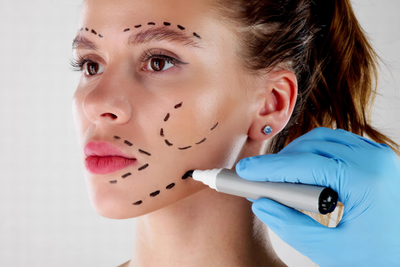
Reference lines and symmetry measurements used to evaluate facial proportions help standardize the process. By using the distances and angles between specific facial landmarks as reference points, it is possible to determine which areas are deficient or dominant relative to others. These reference lines are repositioned according to each patient’s individual facial structure rather than being applied as a fixed template.
Digital imaging and photographic analysis make proportion-related decisions more consistent. Images taken from different angles reveal not only the static appearance of the face but also changes that occur during facial expressions. Comparing these images also makes it easier to monitor how regional volume requirements change over time.
Measurement results are combined with physician experience to form the final decision regarding proportions. Numerical data and imaging results are not decision-making mechanisms in themselves; how these findings are related to the overall appearance of the face depends on the physician’s clinical assessment. Integrating measurement and experience in this way allows the proportions to remain both objective and individualized to the face. The risks that may arise when measurements and proportioning are not performed correctly deserve separate consideration.
What Are the Risks and Complications of Excessive Filler Use?
The risks of excessive filler use include facial asymmetry, an unnatural appearance, and pressure on the tissues. Filler applied without proportioning based on measurement and experience may create excess volume in one region while leaving neighboring areas comparatively underemphasized. This may develop into a visible imbalance that disrupts the overall integrity of the facial contours.
Incorrect proportioning may create conditions that contribute to complications such as migration, edema, and prolonged swelling. Migration, defined as the displacement of filler material from the area where it was applied to another location, generally occurs when the tissue is exposed to more volume than it can accommodate. Edema and swelling that persist longer than normal may also be associated with excessive stretching of the tissue.
Excessive concentration of filler in a single region may create incompatibility with other facial areas, resulting in an imbalanced appearance. For example, when treatment is heavily concentrated in the cheekbone region and remains disproportionate to the chin and midface, the balance of volume between facial regions is disrupted, causing the viewer’s eye to be drawn directly to that area. Aesthetic harmony is based on a balance in which no single region overwhelms the others.
These risks demonstrate why the right-proportion approach is more critical than quantity. Although greater volume may appear to create a noticeable change in the short term, exceeding the amount the tissue can accommodate may open the door to both visual and structural problems. At this point, the relevant question becomes how the excess volume can be reversed.
How Can an Overfilled Appearance Be Corrected?
Correcting an overfilled appearance begins with reassessing the existing volume distribution. The physician examines the face as a whole to determine which region carries excess volume relative to the appropriate proportions. This assessment requires reconsidering the relationships between regions rather than focusing on a single point.
In some cases, dissolving enzyme treatments may be used to reduce excess volume. Enzyme treatment allows excess material accumulated in the tissue to be reduced in a controlled manner. This method does not always mean completely eliminating the filler; the aim is to reduce the volume to a level that is appropriate for the intended proportions.
The goal of the correction process is to restore proportional balance within the face. Removing the excess alone is not sufficient; the relationship with neighboring regions must also be reassessed. Because reducing volume in one area may alter the appearance of other regions, this stage requires careful planning.
Revision performed according to the right-proportion approach can help restore a natural appearance. Following revision, the face may regain an overall harmony in which no single region dominates the others. This approach also provides a reference point for preventing the same proportional error from being repeated during future treatments.